

Article details
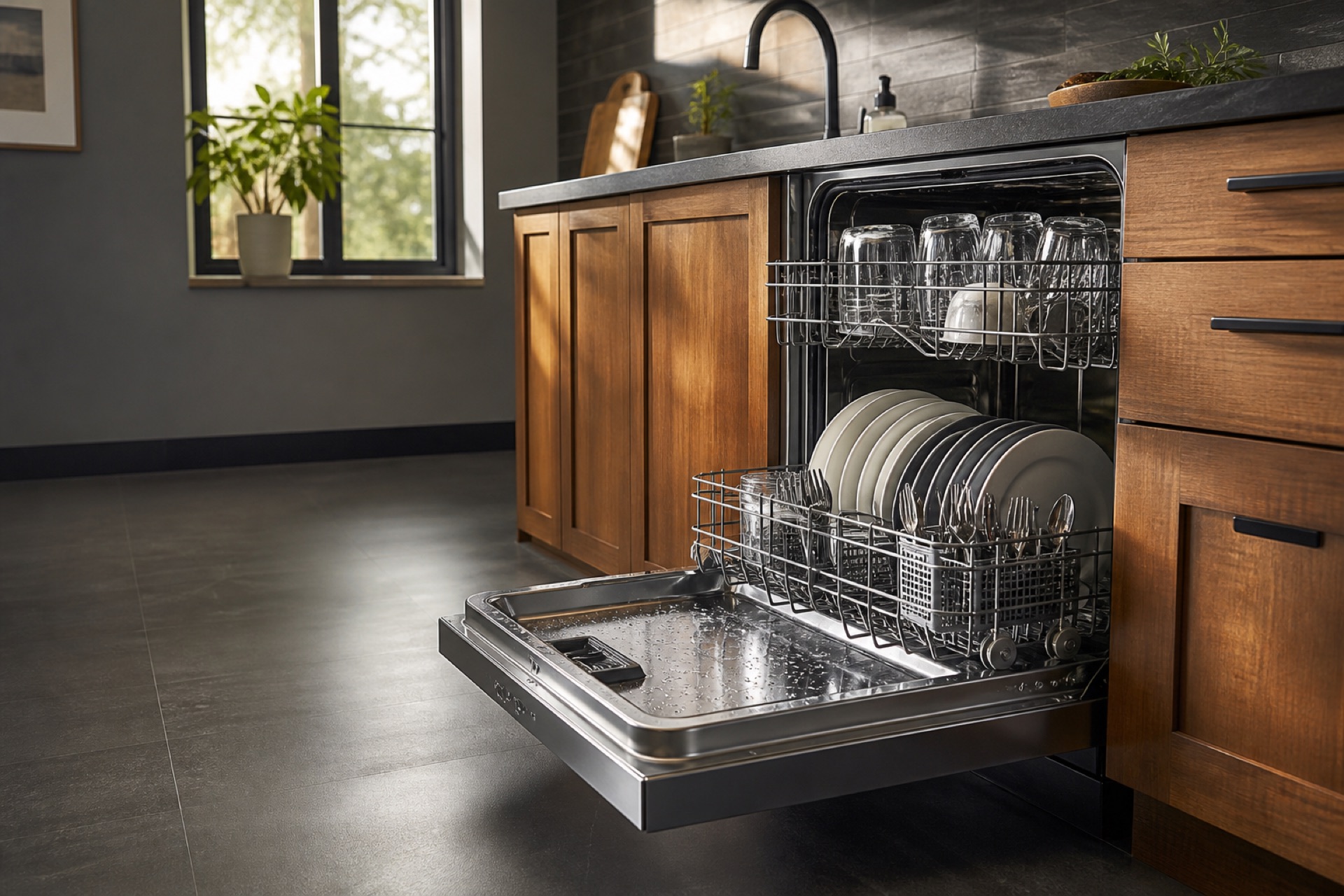
A Kenmore dishwasher that leaves dishes wet usually needs rinse aid, a better load arrangement, or hotter water, rather than a repair. Fill the rinse-aid dispenser with liquid rinse aid, angle cups and plastics so they cannot hold water, and let the cycle finish before opening the door.
Opening the dishwasher to find damp dishes spoils the end of the chore. A symptom like that does not point to one broken part, so begin with observations that are safe, easy to repeat and handy to mention if you later book a Kenmore service visit.
There is routine care, and there is work that needs testing or disassembly; keep the two apart. Do not get around a latch, a safety switch or an error message just to finish a run. Taking brief notes today helps whoever diagnoses the issue find the cause faster.
Start with the simple conditions
Top up the rinse-aid dispenser, make sure its dial is not turned to the lowest setting, and tilt cups and plastic containers so water cannot collect in them. Leave the dishwasher in its normal position and do not force panels, fittings or controls. Once an adjustment makes a difference, run a single ordinary cycle before you draw a conclusion.
Drying by condensation relies on warm surfaces and moving air, so cracking the door before the program ends can weaken the result. Pay attention to whether the dampness shows up every time, only with a certain load or setting, or only late in a run; that matters more than restarting the machine repeatedly. When only one type of item stays damp, suspect how it is loaded. When every load comes out wet, begin with the rinse aid and the water temperature.
| Result | Likely cause | Safe check |
|---|---|---|
| Plastic still damp | The material holds on to water | Tilt pieces so water runs off |
| Water standing in mugs | How they sit in the rack | Face cups downward |
| Wet dishes every time | Rinse aid level or a setting | Top up the rinse aid |
How does rinse aid speed drying?
The guide for one Kenmore dishwasher says it is designed to use rinse aid, which improves drying by letting water drain off dishes after the final rinse. An empty dispenser is the first cause it lists for dishes that do not dry. Use liquid rinse aid only.
Cycles take longer when the dishwasher is connected to cold water, because heating cold water takes time. The manual lists water below 120 degrees Fahrenheit among the causes of spotting and filming.
Safe checks that protect the appliance
Your model’s use-and-care manual covers its controls, filter access and service intervals. Restrict cleaning to parts it labels as owner-serviceable, use the cleaning products it names, and put every removable piece back exactly where it was designed to go.
Prior to another run, remove whatever is in the way, lighten a load that is unusually heavy, and check that airflow, water supply and door clearance are not restricted. Repeated resets are a poor choice, because they can mask a fault that comes and goes and leave water, heat or pressure in the wrong place.
- Note any message or error code that shows before you clear it.
- Inspect visible hoses, vents, seals and plugs while leaving electrical connections alone.
- Perform a single controlled test in place of several rapid ones.
- Confirm that the rinse-aid dispenser still has some in it.
- Put plastics on the top rack only, and only when marked dishwasher safe.
Fine to do yourself
- Add rinse aid
- Arrange items so water drains
- Wait for the cycle to end
Needs a technician
- Opening up heater circuits
- Changing drying controls from the inside
- Using racks that are damaged
How do loading and plastics affect drying?
The guide says plastic items go only in the top rack and only if marked dishwasher safe, and plastic holds water longer than glass or ceramic. Overloading or improper loading is also listed as a cause of poor results.
If glassware turns cloudy as well, the manual links that to too much detergent with hard water, and suggests less detergent and a rinse aid. Foaming from the wrong detergent is a separate problem and not a drying one.
Know when the symptom needs diagnosis
After the simple checks, a symptom that stays the same signals the end of owner-level work. Internal wiring, heater circuits, pumps, motors, refrigerant lines, gas connections and control boards need proper test gear and a technician who can confirm the fix is safe.
Schedule service soon when the unit keeps getting worse, a breaker trips, liquid leaks close to electrical parts, there is a hot or burnt odor, a new grinding noise appears, or it cannot get through a regular cycle. Never keep running an appliance that shows a safety warning.
What to tell the technician
Tell the technician the model number, exactly what happens, when it began, which settings you used and how the safe checks turned out. A photo of a displayed code or a quick description of a noise is useful too, but do not pull a cover off to get it.
Observation cannot stand in for a repair, yet it makes the best first step. Deal with the basic conditions, keep any helpful error details, and leave electrical, gas, sealed-system and internal mechanical jobs to a specialist Kenmore technician.
Common questions
Do I need rinse aid for dishes to dry?
The guide says the dishwasher is designed to use it and lists an empty dispenser as a reason dishes may not dry. Use a liquid rinse aid.
Why are plastics always wet?
Plastic retains water more than other materials. Load plastic only in the top rack if it is marked dishwasher safe, and angle it so water runs off.
What happens if I open the door mid-cycle?
Per the guide, you have four minutes to press Start again or the machine shuts off and loses its settings. Opening the door early also cuts into drying.
Need help now? Visit our services page or contact us.
Official manuals and support notes are available on Kenmore Support.
Get the entire model number written down before you order parts, because board and sensor revisions may change which part number is correct.
One power cycle may clear up a temporary fault. If the same code comes back repeatedly, a physical cause generally remains.
Keep vents and filters free of buildup between visits; blocked airflow can easily be mistaken for an electrical or sensor problem.
If you find water, notice a burning smell or see sparks, shut the appliance down and have a professional take a look.