

Article details
Uneven baking usually comes down to how the oven is used and set up: a full preheat, centered pans with space around them, the right rack, and a level oven. If one side keeps undercooking after those corrections, book a temperature diagnosis rather than adjusting repeatedly.
When the oven turns out food that is done in one spot and raw in another, dinner plans suffer. A single symptom does not single out a failed part, so open with observations that are safe and repeatable and that will matter if you later book a Kenmore service visit.
Day-to-day care belongs in one category and testing or disassembly in another. Never get around a door lock, a safety switch or an error message just to keep baking. A few notes made today can help whoever diagnoses the oven get to the cause with less guesswork.
Start with the simple conditions
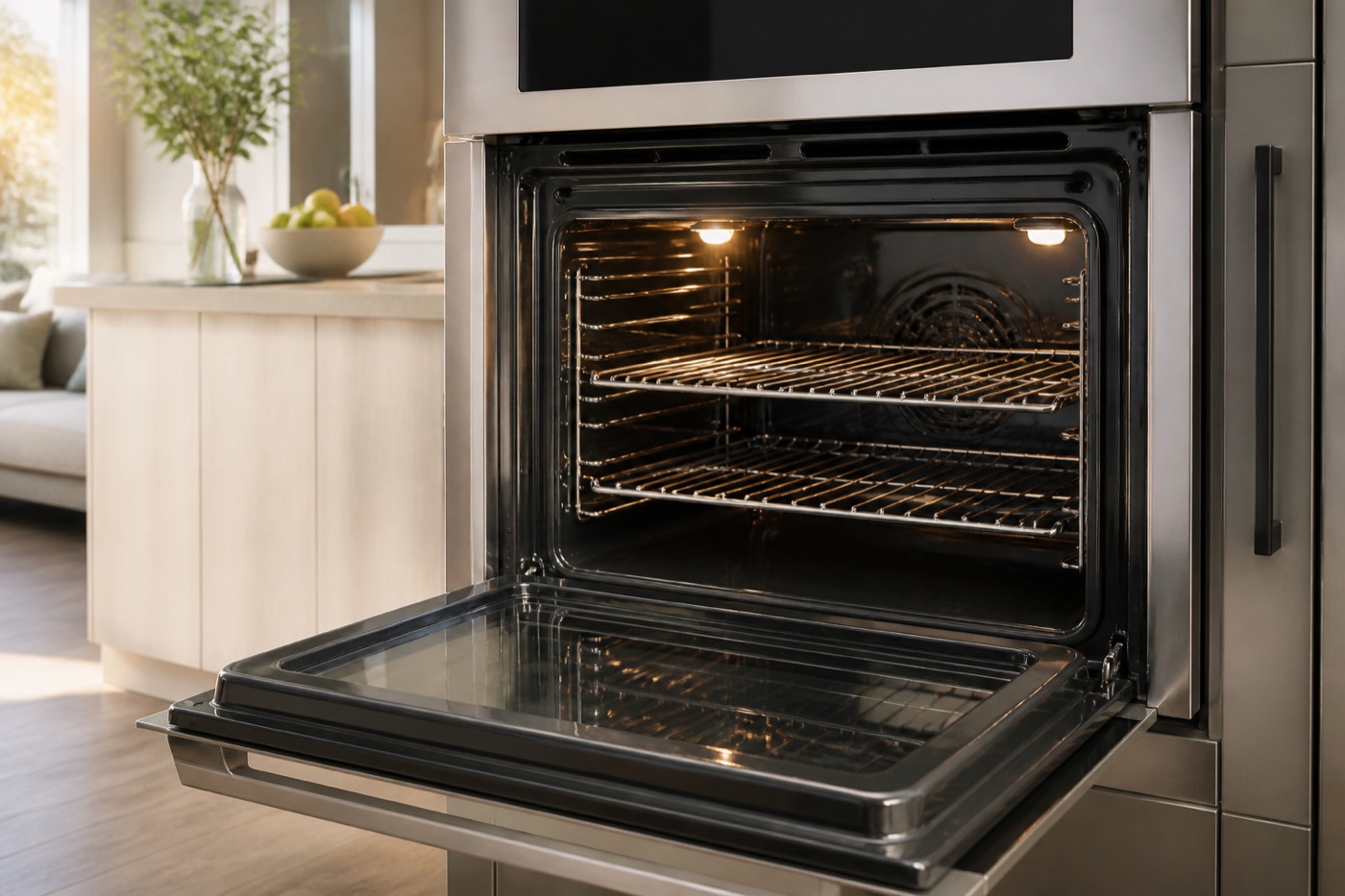
Let the oven preheat all the way, put the food on a middle rack when the recipe permits, and skip oversized pans or packed trays that choke the airflow. Keep the range where it is installed, and do not force panels, fittings or controls. If a small adjustment helps, bake one regular batch before settling on an explanation.
If only a single recipe gives odd results, technique is the more likely culprit, whereas one side that always comes out underdone can justify a temperature diagnosis. Notice whether it happens every time, only with a certain setting, or only deep into a long bake; that tells you more than turning the oven off and on repeatedly. Recipes that behave differently usually do so because of the pan material and the rack position, so change just one variable per test.
| Result | Likely cause | Safe check |
|---|---|---|
| Browning that varies across the tray | Air flow squeezed by crowding | Bake a single tray in the middle |
| Food finishing late | The oven was not preheated fully | Wait until it signals it is ready |
| Big gap between set and actual heat | A sensor or heating element | Arrange for testing |
How should you space pans and racks for even baking?
The manuals for one Kenmore induction range and one slide-in gas range recommend preheating before baking and leaving two to four inches of space around pans. Crowded sheets block airflow, so avoid overcrowding and center pans on the rack. Dark pans absorb heat quickly and can brown the bottoms sooner than shiny ones.
The gas range manual adds that frequent door opening makes food slow to finish. If results run hot or cool, it suggests adjusting the recipe temperature by 25 degrees Fahrenheit before concluding the oven is at fault.
Safe checks that protect the appliance
Your range’s use-and-care manual lists the controls, the points of access and the care intervals that belong to your model. Clean only the parts it designates for owners, rely on the products it recommends, and put every removable piece back the way it was engineered to sit.
Ahead of another bake, take away anything obstructing the oven, ease up on a load that is unusually crowded, and make sure airflow, supply lines and door clearance are free. Hitting reset time after time is unwise: an intermittent fault can stay hidden, and heat or pressure may build where it should not.
- Jot down any displayed message or error code before clearing it.
- Look over exposed hoses, vents, seals and plugs, and leave electrical connections undisturbed.
- Do a single deliberate test rather than many rapid ones.
- Let the oven finish preheating before the food goes in.
- Set a cup of water on the rack to see whether the oven sits level.
Reasonable to try
- Move the rack to another position
- Pick the right cooking mode
- Complete the preheat
Needs a technician
- Taking out heating elements
- Measuring live voltage
- Forcing the latch on the door
Can an oven that is not level bake unevenly?
An oven that is not level can make cakes rise unevenly. The manuals suggest placing a level, or a water-filled measuring cup, on the rack and adjusting the leveling legs if needed. This matters most on a newly installed range or one that was moved for cleaning.
A convection fan stops when the door is opened, and some models keep a cooling fan running after the oven is off, which is described as normal. A lopsided result is therefore not always a fan problem.
Know when the symptom needs diagnosis
When the symptom stays put after the simple checks, you have reached the limit of what an owner should do. Internal wiring, heating circuits, motors, refrigerant lines, gas connections and control boards call for suitable test equipment and a technician who can confirm the repair is safe.
Call for service promptly if results keep getting worse, a breaker trips, something leaks close to electrical parts, you notice a hot or burnt smell, a new grinding noise starts, or a normal cycle will not complete. Do not carry on using an appliance that displays a safety warning.
What to tell the technician
Offer the model number, a clear description of what the oven does, the date it began, the settings used and what the safe checks found. A photo of a code, or a short account of a noise, is helpful, but a cover should never come off just to get one.
Close observation is no stand-in for a repair, yet it is the right first step. Take care of the basic conditions, keep any error details worth saving, and let a specialist Kenmore technician take on electrical, gas, sealed-system and internal mechanical work.
Common questions
Should I change the temperature when food bakes unevenly?
One manual suggests adjusting the recipe temperature by 25 degrees Fahrenheit if the oven seems too hot or too cool. Fix pan spacing, rack position and levelness first, since they affect results as much as the dial.
What if the oven shows an F or E code?
The manuals say to press STOP and try Bake or Broil again. If the code repeats, turn off power, wait five minutes, restore power and reset the clock, and call for service if it returns.
Can cleaning affect how the oven cooks?
Heavy spills and grease can cause smoke from the vent, so wipe up spills before heating. Foil on the oven bottom or entire racks traps heat, and the manual warns against it.
Need help now? Visit our services page or contact us.
Official manuals and support notes are available on Kenmore Support.
Make a note of the whole model number prior to purchasing parts, as revised boards and sensors can change the part number you need.
A one-time power reset may clear a passing fault; a code that comes back again and again points toward a physical cause that persists.
Do not let vents and filters get blocked in the interval between visits, since reduced airflow can pass for an electrical or sensor fault.
Should water, a burning odor or sparks be present, stop using the appliance and have a professional inspect it.